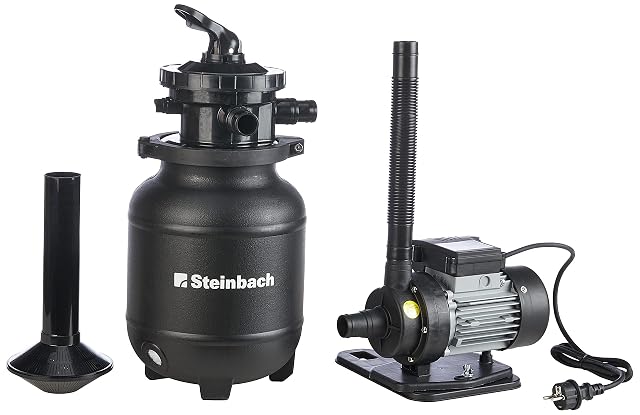
Cartridges are rinsed and eventually thrown away. Sand is backwashed and lasts years. The upgrade is real, and it brings a plumbing job and a water cost with it.
Everything else in this list is a preference. The grain range of the medium is not. Too fine and it passes the laterals and ends up on the pool floor; too coarse and the vessel filters less than it was built to.
The vessel manual states what it wants. The sack states what it is. Those two numbers have to meet, and no other specification on any of these pages matters as much.
Two systems, two scales
The systems here are rated in litres per hour at a reference head, and that rating is a ceiling. Real flow falls with every metre of hose and every bend, and a pump rated generously on paper can deliver a good deal less in a garden installation with a long run to the pool.
One of them carries a timer. Turnover is a daily total, so a timer is worth more than a percentage of extra flow.
Sand or glass
Both are graded media doing the same mechanical job. Glass costs more, is lighter to handle per volume and is sold with claims about how long it lasts before channelling. Sand is the reference case and the cheaper sack.
The valve is part of the decision
A multiport valve is bought against a thread size in inches and a mounting position, not against a brand. If you are assembling a system rather than buying one boxed, that compatibility is the first thing to establish and the easiest to get wrong.
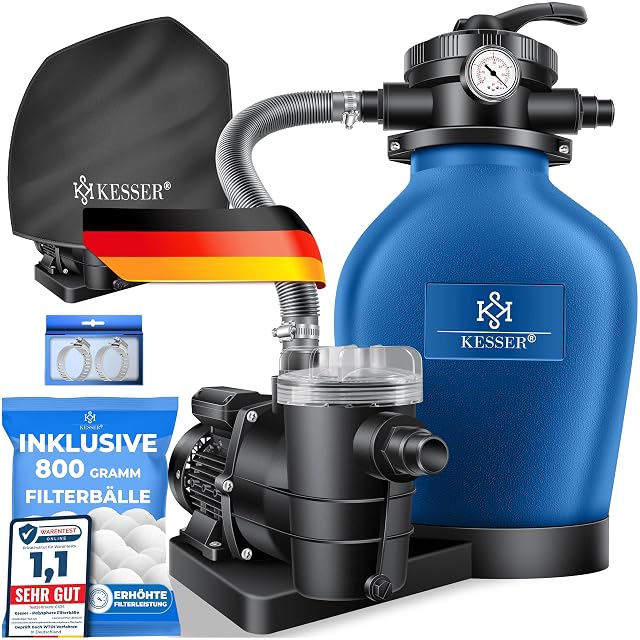
A filter-ball system publishing two flow figures and two limits nobody else states: a maximum water temperature of 35 °C, a salt tolerance of 5 g/l — and that the pump is not self-priming.
Best for: A salt pool up to 19 000 litres where the system can sit below the water line
The only filter system on this shelf that publishes a noise level with a distance — 60 to 65 dB(A) at one metre — alongside 10 200 l/h from a 400 W pump and 800 g of filter balls.
Best for: A system sited near a terrace, where the decibel figure is the deciding one
The comparison depends on the medium and the flow rate rather than on the principle. What a sand filter reliably changes is the labour: backwashing takes minutes and no consumable, where a cartridge is rinsed repeatedly and then replaced. Backwashing does send pool water to waste, which is its own cost.
Can filter glass replace sand in the same vessel?
Glass is sold as a drop-in alternative graded the same way, and the grade is what has to match — particle size decides whether the medium stays in the filter or passes through the laterals into the pool. Claims about finer filtration than sand belong to the maker and are reported here as the maker’s.
What does the multiport valve do?
It routes water through the vessel in different directions: filtering, backwashing, rinsing, draining, or bypassing entirely. It is specified by its port size and its mounting — top-mount or side-mount — and both have to match the vessel it sits on.
The models here come from the catalogue of this site. Specifications are those published by the manufacturer and on the Amazon product page; prices are what Keepa reported on the date below, and both move. The ranking uses declared specifications, the balance of stated strengths and limitations, and price. No product on this site has been physically tested, and nothing here claims otherwise.
Last checked on
The tool we use ourselves
Chosen the model? Now find out whether the price is real.
Pool equipment is cut and re-cut across the year — most violently in
September, when the shelves are cleared for the season nobody is
thinking about any more — and a struck-through figure tells you
nothing at all about what the same reference cost in June.
UniverTrack holds a week-by-week record per retailer,
so a reduction is measured against a price somebody genuinely paid
instead of one written for the banner — and it says when the moment to
order has actually come.
Real price historyBuy-now alertsAI buying assistant