A tank, a media bed, and a valve with six or seven positions · review
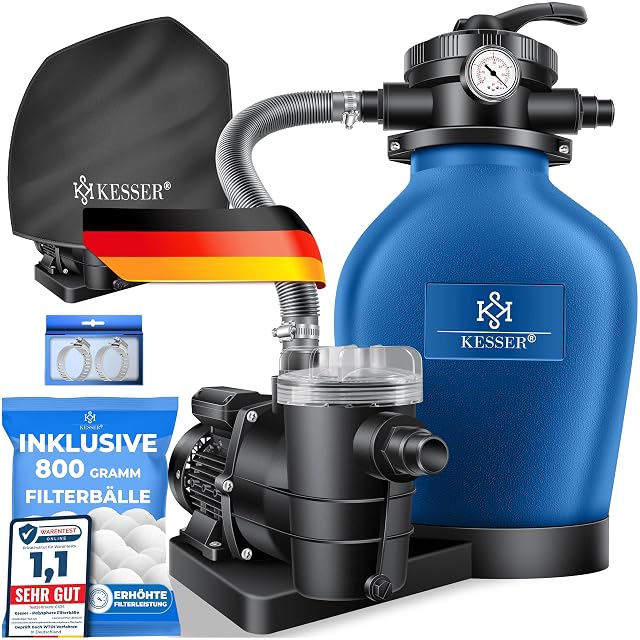
Mauk 16 l Sand Filter System with Filter Balls review
The smallest and cheapest system here, with a transparent lid so the bed can be watched, a set of filter balls in the box, and a TÜV Rheinland certificate quoted with its ID number.
The bottom line The small one, and unusually honest about being small. Two flow figures, a visible bed, the medium in the box and a certificate with a number are four things the rest of this shelf mostly skips. What it will not tell you is how many valve positions it has, what the pump draws or what hose it takes — and on a sand system the valve is the thing you operate every week.
On the maker’s own page
A 16-litre sand filter system with a pump, supplied with a filter ball set in
100 % recyclable polyethylene. Throughput is stated at up to 2 700 l/h with a
maximum delivery of 4 500 l/h. The lid is transparent so the filtering can be
watched and the level of soiling seen.
The system is stated TÜV Rheinland certified, with the ID number 1111297578,
and is described as suitable for pool, spa, hot tub or aquarium.
Two flow figures, at the bottom of the shelf
2 700 l/h throughput and 4 500 l/h maximum delivery. Two numbers rather than
one, which is a rarer thing on this shelf than it should be.
What they are not is a turnover. Turning a pool over means passing its whole
volume through the medium, and that depends on the pool. The page prints the
maker’s figures and the arithmetic stays visible.
The lid
A filter bed is opaque in every sense: nothing about it is visible until the
pressure gauge moves, and a channelled bed does not move the gauge at all.
A transparent lid is the only direct look at the medium anybody on this shelf
offers, and it costs nothing.
Left off the page
Valve positions — the function list that a sand system is operated through, and
which seven other systems here publish. Pump power in watts. Hose size. Tank
diameter.
Four absences on a listing that does publish two flows, a medium, a
certification and an ID number. It is a particular shape, and the page records
it rather than filling the rows in.
Availability
The German Amazon store sat at roughly 80 € at the single check this page is built on.
The American, British, French, Italian and Spanish Amazon stores gave back nothing, so the buy button there lands on a search instead of a blank page.
These figures are what Keepa gave back the day this page was last written. Stock and prices shift without warning.
Prices quoted in this text were read on 21 September 2026. The live price is at the top of the page.
Declared figures, and the gaps between them
Strengths
Filter balls supplied, where five systems here supply a token quantity and one supplies none
A transparent lid, so the state of the bed is visible without opening anything
A TÜV Rheinland certificate quoted with its ID number — the only traceable certification in this family
Two flow figures published rather than one
Compromises
No valve positions published, which is the function list a sand system is operated through
No pump power, no hose size and no tank diameter
A 16-litre tank is the smallest here by a wide margin
Specifications
Flow rate
2 700 l/h throughput, with a maximum delivery of 4 500 l/h
Turnover against volume
Not published as a turnover — the maker states suitability for smaller to medium pools
Tank diameter
Not published — tank volume stated as 16 litres
Media charge
A filter ball set is supplied; no weight is published
Media type
Filter balls, stated as 100 % recyclable polyethylene
Valve positions
Not published
Pump power
Not published in watts
Timer
Not published
Hose size
Not published
Amazon reference
B0FSLHHFK3 (one reference across 1 Amazon marketplace)
EAN
4043722028590
The questions this one raises
Why does a transparent lid matter?
Because a filter bed gives no other sign of its state until the pressure rises. Seeing the medium and the water above it turns a guess into a look. It is the only system in this family to offer it.
Are filter balls as good as sand?
They are lighter, the charge is smaller, and makers claim they do not cement into channels the way old sand can. What nobody on this shelf publishes is a measured fineness for either. This listing states polyethylene and recyclability and no micron figure.
What does the TÜV number mean?
That a certificate exists and can be looked up — the ID is quoted in the listing. It is a traceable claim rather than a badge, which is unusual here. What the certificate covers is a matter for TÜV Rheinland rather than for this page.
Who this one is for
A small pool or a spa where the bed being visible matters more than the flow
Price and availability
Details checked on September 21, 2026.
Sources
Specifications: manufacturer sheet and Amazon product page. Prices and availability: Keepa. No product on this site has been physically tested.
The only filter system on this shelf that publishes a noise level with a distance — 60 to 65 dB(A) at one metre — alongside 10 200 l/h from a 400 W pump and 800 g of filter balls.
Best for: A system sited near a terrace, where the decibel figure is the deciding one
6 056 l/h pump, 4 920 l/h through-flow, 38.5 cm tank, 36 kg sand
The listing that states its media requirement in full — 36 kg of #20 quartz sand or 1 000 g of filter balls, neither included — alongside two flow figures, a 38.5 cm tank and both hoses in the box.
Best for: A first sand system, where knowing exactly what else to order is worth more than a headline flow
A 250 W system publishing both ends of its curve — 9 000 l/h and a maximum head of 7.5 m — with a seven-position valve, a pressure gauge, IPX5 and adapters for both hose sizes.
Best for: A mid-sized pool where knowing the head before ordering matters